From Test Scores to Life Skills: What Your Child Really Needs from Tuition

From Test Scores to Life Skills: What Your Child Really Needs from Tuition
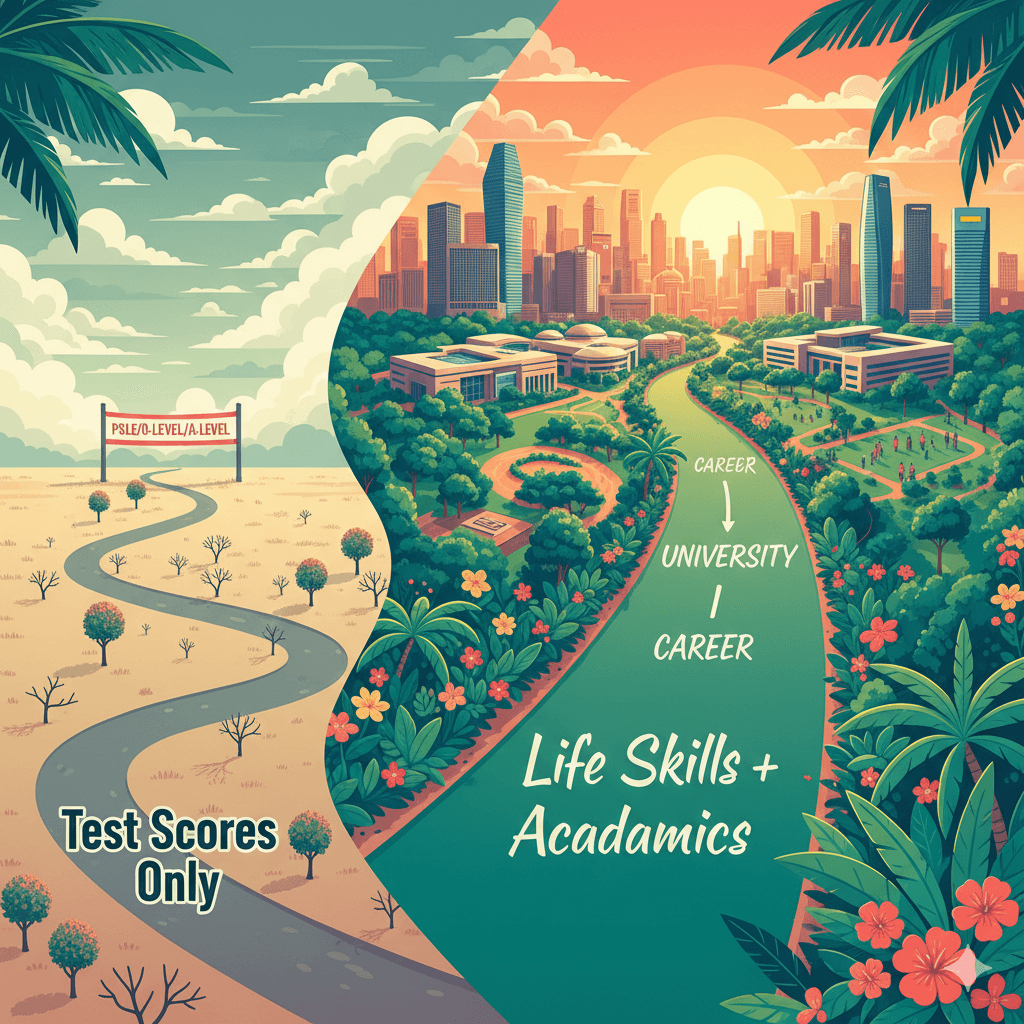
If you could glimpse your child's future—say, 15 years from now—what would you want for them? Chances are, your vision includes more than just strong O-Level or A-Level results. You probably imagine them thriving in university, succeeding in meaningful work, building healthy relationships, and navigating life's challenges with resilience and confidence.
Here's the uncomfortable question: does their current education actively prepare them for that future?
For many students in Singapore's tuition landscape, the answer is troubling. They're learning to excel at examinations while missing crucial capabilities they'll need for everything that comes after. They can execute algorithms flawlessly but struggle to think independently when facing unfamiliar problems. They've mastered test-taking strategies without developing the adaptability, critical thinking, and self-direction that define successful adults.
At Our Learning Loft, we believe your child deserves better. Strong academic foundations matter—but they're just the starting point, not the destination. Real educational success means developing transferable life skills alongside subject mastery.
The Skills Gap in Traditional Tuition
Walk into most tuition centers and you'll see the same pattern: students working through practice papers, memorizing content, drilling procedures. Ask what they're learning, and they'll name subjects—Mathematics, Science, English. Ask what skills they're developing, and you'll often get blank looks.
This is the hidden cost of test-prep-only approaches: they optimize for one narrow outcome (exam performance) while neglecting the broader capabilities students need for long-term success.
What gets lost:
The ability to analyze complex situations and identify key issues. The capacity to generate creative solutions when standard approaches don't work. The skill of learning independently without constant teacher direction. The confidence to tackle unfamiliar challenges instead of freezing when faced with the new or unexpected.
These aren't abstract virtues—they're practical necessities for university coursework, professional careers, and navigating adult life. And they don't develop automatically from content knowledge. They require explicit cultivation.
Critical Thinking: The Meta-Skill Behind All Learning
Perhaps the most important capability students need is one that rarely appears on syllabuses: critical thinking.
Critical thinking means more than "thinking hard" about content. It's the capacity to analyze information, evaluate evidence, identify assumptions, consider alternative perspectives, and construct well-reasoned conclusions. It's the difference between accepting information passively and engaging with it actively.
In our holistic learning center, critical thinking development happens continuously:
Rather than simply teaching persuasive writing formulas, we analyze actual arguments to identify logical fallacies, unsupported claims, and rhetorical manipulation. Students learn to ask: "What's the evidence?" "What perspective is missing?" "What assumptions underlie this position?"
In science lessons, we don't just memorize facts about ecosystems—we evaluate competing conservation strategies, considering trade-offs between different values and interests. Students develop the habit of asking "What are the consequences?" and "Who benefits from this approach?"
When studying historical events, we examine multiple primary sources with conflicting accounts. Students grapple with the reality that perspective shapes interpretation, and learning to navigate this complexity is crucial for becoming informed citizens.
This isn't enrichment added after academic content is covered—it's how we teach academic content. Because critical thinking isn't a separate subject; it's the foundation for all meaningful learning.
Problem-Solving Beyond Pattern Recognition
Singapore students are often exceptionally skilled at solving familiar problem types. They've practiced extensively, recognized patterns, and can execute solutions efficiently. This capability is valuable, but limited.
Real-world problems don't come pre-categorized by type with helpful hints about which formula to apply. They're messy, multifaceted, and often require combining knowledge from multiple domains in novel ways.
Our 3E Framework explicitly develops authentic problem-solving:
Through Educate, we ensure students understand underlying principles, not just procedures. A student who grasps why geometric theorems work can adapt them to unfamiliar configurations. A student who understands the logic behind grammatical rules can construct correct sentences they've never encountered before.
Through Expose, we present problems that don't fit neat categories. Students learn to analyze situations, identify relevant knowledge, and determine appropriate approaches. They develop tolerance for ambiguity and the persistence to work through challenges that don't have obvious solutions.
Through Elicit, we draw out students' natural problem-solving creativity. In our small class tuition environment, we have time to explore different solution strategies, discuss what works and why, and help students develop their own problem-solving metacognition.
The result: Students who don't panic when facing the unfamiliar. They've practiced the process of making sense of new challenges, testing approaches, learning from what doesn't work, and persisting to successful solutions. This is transferable skill development that serves them across all subjects and far beyond formal education.
Self-Directed Learning: The Ultimate Educational Goal

Here's a metric that matters more than test scores: how well can your child learn independently?
In university and professional life, no one assigns practice papers or tells students exactly what to study. Success requires the ability to identify what you need to learn, find appropriate resources, assess your own understanding, and adjust your approach based on results.
These self-directed learning capabilities develop through practice—but most traditional tuition actually inhibits their development. When teachers provide constant direction, students become dependent. They learn to wait for instructions rather than taking initiative.
Our personalized learning approach deliberately builds learner autonomy:
We teach students to set specific learning goals for themselves, not just "do well on the test" but "understand why probability calculations work" or "improve my essay introductions."
We help students develop metacognitive awareness—the ability to monitor their own understanding. Can they explain a concept to someone else? Do they know what they don't know? What strategies help them learn most effectively?
In our small group settings, students regularly make choices about their learning: which practice problems to tackle, whether they need more examples or are ready to advance, how to allocate study time across different skills.
This might sound like students are left to flounder. The opposite is true. Self-direction develops through carefully scaffolded support—something only possible with the individualized attention our small class sizes provide.
Resilience and Growth Mindset: Emotional Skills for Academic Success
Your child's emotional relationship with learning determines their educational trajectory as much as their intellectual capabilities.
Students who view intelligence as fixed give up quickly when facing difficulty—why persist if you simply "aren't good at" this subject? Students who believe abilities develop through effort treat setbacks as temporary and challenges as opportunities to grow.
This distinction—what psychologists call "growth mindset"—isn't just feel-good psychology. It's a practical factor that shapes how students respond to the inevitable difficulties in learning.
Our holistic education model actively cultivates growth mindset:
We structure lessons so students regularly encounter appropriately challenging material—difficult enough to require genuine effort, but achievable with persistence and support. Success that comes from overcoming real challenges builds authentic confidence and reinforces the connection between effort and outcomes.
We explicitly teach students that struggle is a normal part of learning, not evidence of inadequacy. In our small class environment, students see peers wrestle with concepts and break through to understanding. This normalizes difficulty and models productive response patterns.
When students face setbacks, we help them analyze what happened and adjust their approach rather than accepting defeat. Poor performance on a test becomes diagnostic information: "Which concepts need more work? What study strategies should you try differently?"
This emotional resilience—the capacity to persist through difficulty, recover from failure, and maintain motivation through challenges—may be the most valuable outcome education can provide.
Communication and Collaboration: Skills for the Social World
Even subjects like mathematics that seem purely individual actually benefit from social learning. Explaining your reasoning to peers deepens understanding. Hearing different solution approaches expands your cognitive toolkit. Collaborating on complex problems builds capacities you'll use throughout professional life.
Yet large group tuition often emphasizes individual work almost exclusively. Students sit side-by-side but learn in parallel rather than together.
Our small group tuition structure creates regular opportunities for collaborative learning:
Students work together on challenging problems, negotiating different approaches and combining their strengths. They learn to articulate their thinking clearly, listen actively to others, and build on peer contributions.
During discussions, students practice respectfully disagreeing with interpretations and defending their reasoning with evidence. They learn that intellectual debate isn't personal conflict—it's how communities of learners collectively deepen understanding.
These communication and collaboration skills don't just make students better learners—they're essential capabilities for every professional field and for civic participation in democratic society.
Time Management and Organization: The Hidden Curriculum
Ask struggling students what's wrong and they often identify the same issues: "I don't have enough time," "I feel overwhelmed," "I forget what I'm supposed to do."
These aren't academic problems in the traditional sense—they're executive function challenges that undermine academic performance. And they're learnable skills, not fixed personality traits.
Our quality tuition center approach includes explicit support for these practical capabilities:
We help students develop realistic planning systems for managing assignments and study time. We teach specific organizational strategies for tracking different subjects' requirements. We guide students in breaking large projects into manageable tasks and setting intermediate deadlines.
In our small class setting, teachers can notice when individual students are struggling with organization and provide targeted support. They can check in on whether students are implementing planning strategies effectively and adjust recommendations based on what's actually working for each person.
These might seem like "soft skills" compared to subject mastery, but they're often the differentiating factors between students who realize their potential and those who underperform despite strong capabilities.
The Integration: How Life Skills Strengthen Academics
Here's what often surprises parents: developing these broader life skills doesn't compromise academic outcomes—it enhances them.
The student with strong critical thinking skills approaches exam questions more strategically. The student with growth mindset persists through challenging topics instead of giving up. The student with self-directed learning capabilities reviews material more effectively. The student with emotional resilience maintains performance under exam pressure.
Life skills and academic skills aren't competing priorities—they're mutually reinforcing elements of effective learning.
At Our Learning Loft, we don't separate character development from content instruction. Our 3E Framework ensures every lesson simultaneously builds subject knowledge and transferable capabilities. Students aren't just learning mathematics—they're developing logical reasoning. They're not just studying literature—they're practicing empathetic perspective-taking and nuanced communication.
Preparing for Unknowable Futures
Your child will likely work in careers that don't yet exist, using technologies not yet invented, solving problems we can't currently imagine. This isn't speculation—it's the reality of rapid technological and social change.
No tuition center can teach the specific knowledge your child will need 20 years from now. What we can do is develop the capabilities that make continuous learning possible: critical thinking to evaluate new information, problem-solving to tackle novel challenges, self-direction to identify and pursue needed knowledge, resilience to persist through difficulty.
These are the 21st century skills that remain valuable regardless of how the world changes.
Making the Choice That Matters
When selecting a tuition center, it's natural to focus on immediate academic outcomes. But we encourage you to ask larger questions:
Is my child developing the thinking skills they'll need when facing unfamiliar problems? Are they learning to learn independently, or becoming dependent on constant teacher direction? Are they building resilience, or just building test-taking strategies? Are they preparing for exams, or preparing for life?
At Our Learning Loft, we believe these aren't different questions. Proper preparation for exams includes developing critical thinking, problem-solving, self-direction, and resilience. Students who possess these capabilities perform better academically and are far better prepared for everything that comes after.
Your child deserves an education that opens futures, not just one that optimizes for next month's test. That's what comprehensive, future-ready education looks like—and that's what we're committed to providing.